
Working the soil
What a tined implement does, and why a workable seedbed depends on more than another pass.
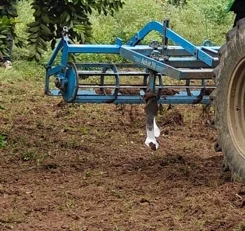
Behind the tractor, the blue frame carries a series of downward-facing tines. This is the working end of cultivation: the points meet the soil while the frame keeps their arrangement. The photograph lets us see the implement, but does not establish its working depth or the condition of the whole field.
Tines, clods and a seedbed
TNAU describes cultivators used in seedbed preparation to loosen soil and break clods. Suitable arrangements can also be used for inter-row work. That does not make every cultivator suitable for every standing crop: spacing, clearance, depth and the crop’s roots all matter. [1]
The tractor supplies movement and carries or draws the implement. The result depends on the soil as well as the machine. A fine-looking surface can conceal compacted ground beneath, so the next question is whether the rooting zone and drainage are suitable for the crop.
Decide what the pass is for
Name the job before choosing the implement. Is the aim to prepare a seedbed, manage weeds between rows, incorporate material or correct a specific surface condition? Each needs a different assessment. An extra pass is an operation with a cost and an effect on the soil, rather than an automatic improvement.
The farm archive distinguishes work such as rotavator passes and levelling. Keep those operations separate in a field history; one does not prove that another was completed.
A useful record
Keep the implement, purpose, soil condition and area with the date. After the pass, inspect several places rather than only the headland. Before adjustment or work beneath raised equipment, isolate the machine and secure it according to its instructions. Hydraulic lift alone is not a safe support. [2]
Sources & further reading
- TNAU · Cultivators and their componentsAccessed 2026-10-23
- HSE · Working safely with agricultural machineryAccessed 2026-10-23