Rice, one field at a time
Five varieties, a small trial for our own kitchen, and the work between a nursery and a harvest.
Our Kharif 2026 season, through 20 October.
By the middle of October, our small Navara red-rice trial had reached harvest. Elsewhere on the farm, people were still going through standing rice to remove unwanted paddy by hand, while insect trouble in Sonam needed another round of treatment. The season had arrived at several different places at once.
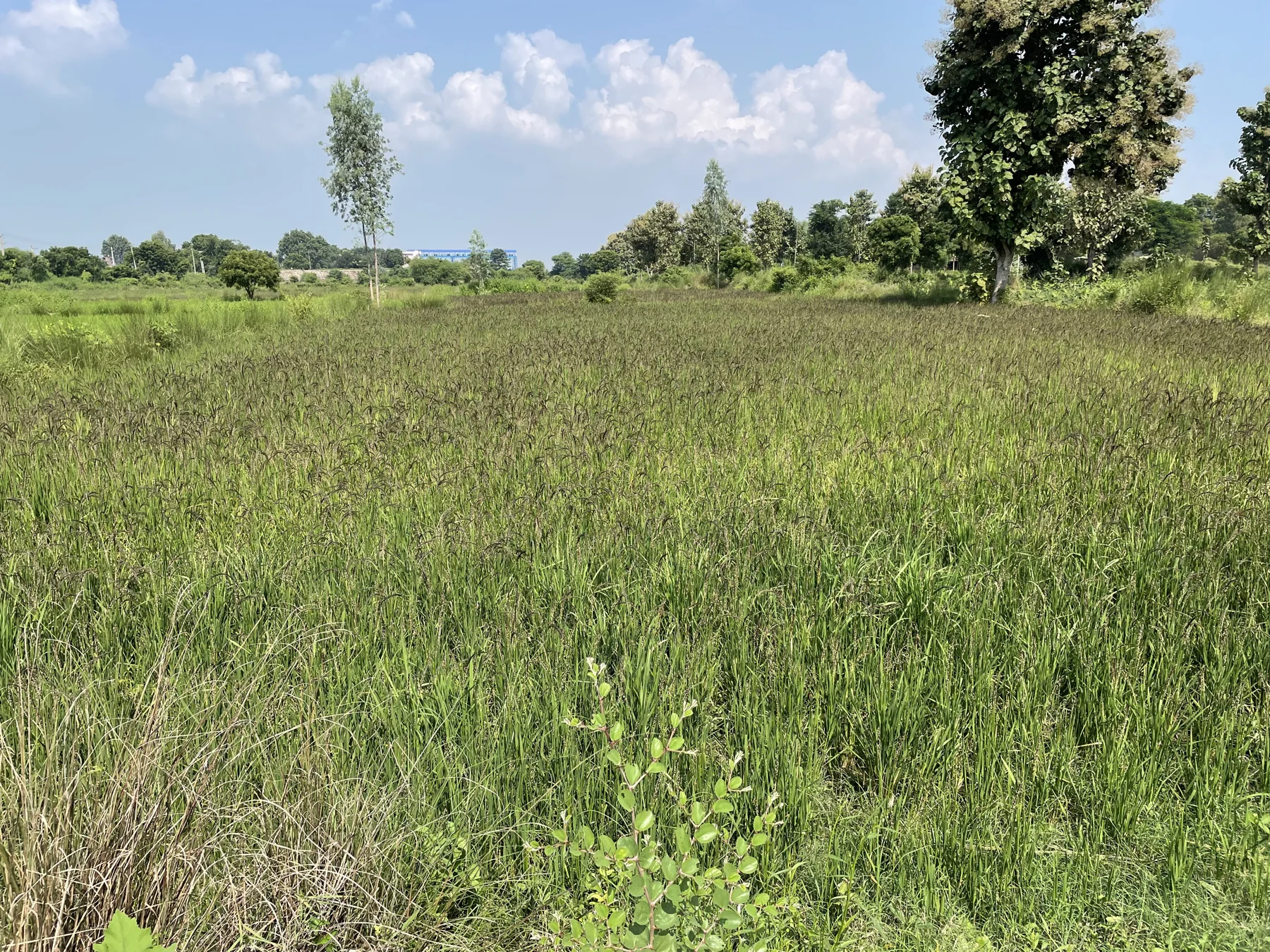
From a distance, the rice fields could look like one continuous crop. Walking through them meant keeping track of five varieties—Vishnu Bhog, Sonam, Kala Namak, 1718 and Navara—along with different planting dates, a separately direct-sown block and patches where rain had interrupted the work. Some of the same water that had to be arranged for planting would later have to be pumped away. A field becoming green was only the beginning of looking after it.
A nursery before a field
In June, we began with seed cleaning. Vishnu Bhog seed was winnowed on 18 June, separating unwanted material before the nursery was sown on 23 June. More nurseries followed in early July for Sonam, Kala Namak, Navara and 1718.
Young rice forms a close carpet of green in the nursery, with clear edges between the planted patches and the paths around them. Growing seedlings together here gives the transplanted crop its first stage in a relatively small space. Later, those seedlings have to be lifted and moved into the prepared main fields. Along the nursery edge, people work bent over the seedlings, handling the young plants by hand.
One block of 1718 took a different route. Its seed was broadcast directly in the main field on 13 July, so there was no nursery to lift or transplant for that section. It remained a separate job in the weeks that followed: herbicide work in a direct-sown section was complete by 19 August, and fertilisation of the direct-sown 1718 was recorded on 1 September. Establishing rice by a different method did not remove the need to return to it for weeds and feeding.
As rice grows, it produces additional shoots from the base, called tillers. That is part of how a planting develops from individual seedlings into a fuller stand; later, some of those stems carry the grain heads. The nursery, the newly established field and the crop with panicles above its leaves are different stages of the same plant's development. FAO's account of rice growth [1]
Bringing water in, then getting it out
The Navara trial was transplanted on 23 July. Transplanting began in 1718 on 27 July and Vishnu Bhog the following day, with Vishnu Bhog continuing into early August. At first, the monsoon had not supplied enough water, and irrigation equipment was being shared between the rice and the young banana plantation. Planting had to progress around the water and equipment available.
Then heavy rain changed the job. By the end of July, a low section needed drainage while transplanting elsewhere continued as conditions and labour allowed. On 8 August, a waterlogged area needed pumping again. The water taken out of that section was used for irrigation and transplant preparation elsewhere on the farm: excess in one place became a supply for another.
The effect lasted beyond the rain itself. By late August, one pond-side area had drained and its crop had survived, but persistent standing water was still preventing work elsewhere. Feeding was incomplete in some of those areas. There was no single day when the whole farm could simply move on from flooding; access and the next operation depended on which field we were talking about.
Feeding a crop we could not work everywhere at once
By the end of August, that round of nutrient work was finished in Vishnu Bhog and Navara, while Kala Namak, 1718 and Sonam were still being worked through. The direct-sown block followed its own sequence into September. The work depended on access to each field while the different plantings continued to grow.
In the second half of September, we were working through the later top-dressings, feeding the established crop. Vishnu Bhog's second top-dressing used urea and was complete by 24 September. In 1718 and Sonam, the recorded round included urea, potash and single superphosphate, usually shortened to SSP; Sonam also received zinc. Rain interrupted that work, and the remaining areas were finished over the following days. By 30 September, seasonal soil fertilisation was complete across the paddy crop.
Those inputs supply different nutrients. Nitrogen from urea supports leafy growth and tillering; phosphorus from SSP plays a part in root development and the plant's energy processes. Potassium supplied by potash helps regulate water and move the products of photosynthesis through the plant, with a role in developing grain. Zinc is a micronutrient, needed in smaller quantities for growth and enzyme functions. IRRI on crop nutrition [2], University of Florida on plant nutrients [3], University of California on potassium in rice [4]
How much fertiliser a field needs also depends on its soil supply, previous crops and stage of growth.
Leaves that needed another look
While the feeding work continued, leafroller activity appeared in 1718 in September. A planned insecticide application was delayed by rain, and spraying then progressed through the affected areas over the following days. Most of that work was complete by 22 September, with one area still pending.
Rice leafroller is a leaf-feeding caterpillar. It folds the blade around itself and feeds inside, leaving pale or transparent streaks where green tissue has been eaten. Visible feeding damage alone does not establish a need to spray; scouting has to consider the crop stage and how much of it is affected. National Plant Protection Centre's leafroller description [5]
In October, leafroller was also identified in Sonam, and another treatment round followed there. The affected Sonam fields had been sprayed by 18 October. Finishing September's applications had not meant that insect checks, or the possibility of another job, were over.
The rice we had not planted
Early October brought a different problem among the crop: unwanted paddy, which we call Jhanga. It was found in several fields, particularly Vishnu Bhog, and removing it meant going back through the rice by hand.
Even that work could not happen everywhere on the same day. In one area, the unwanted plants were still too short to pick out effectively from the cultivated rice. Removal there was deferred until they stood high enough to distinguish. Elsewhere, the hand work was already under way. This was a decision about what could be identified in those fields at that time, rather than a fixed calendar for weeding.
Vishnu Bhog's Jhanga removal was complete by 9 October. A spray intended to support growth and grain filling was then under way in that crop, even though its soil-fertiliser programme had already finished. In 1718, significant Jhanga infestation led to removal work starting on 13 October. It was still going on five days later, alongside the Sonam insect treatment, and was completed on 20 October.
What appeared above the leaves
By October, panicles—the branched heads that carry the rice grains—were emerging above the foliage. Kala Namak looked uneven because its panicles were appearing at different times, although the stems and panicles generally looked good. Much of the transplanted 1718 was also looking encouraging, with developing green panicles across the standing crop.
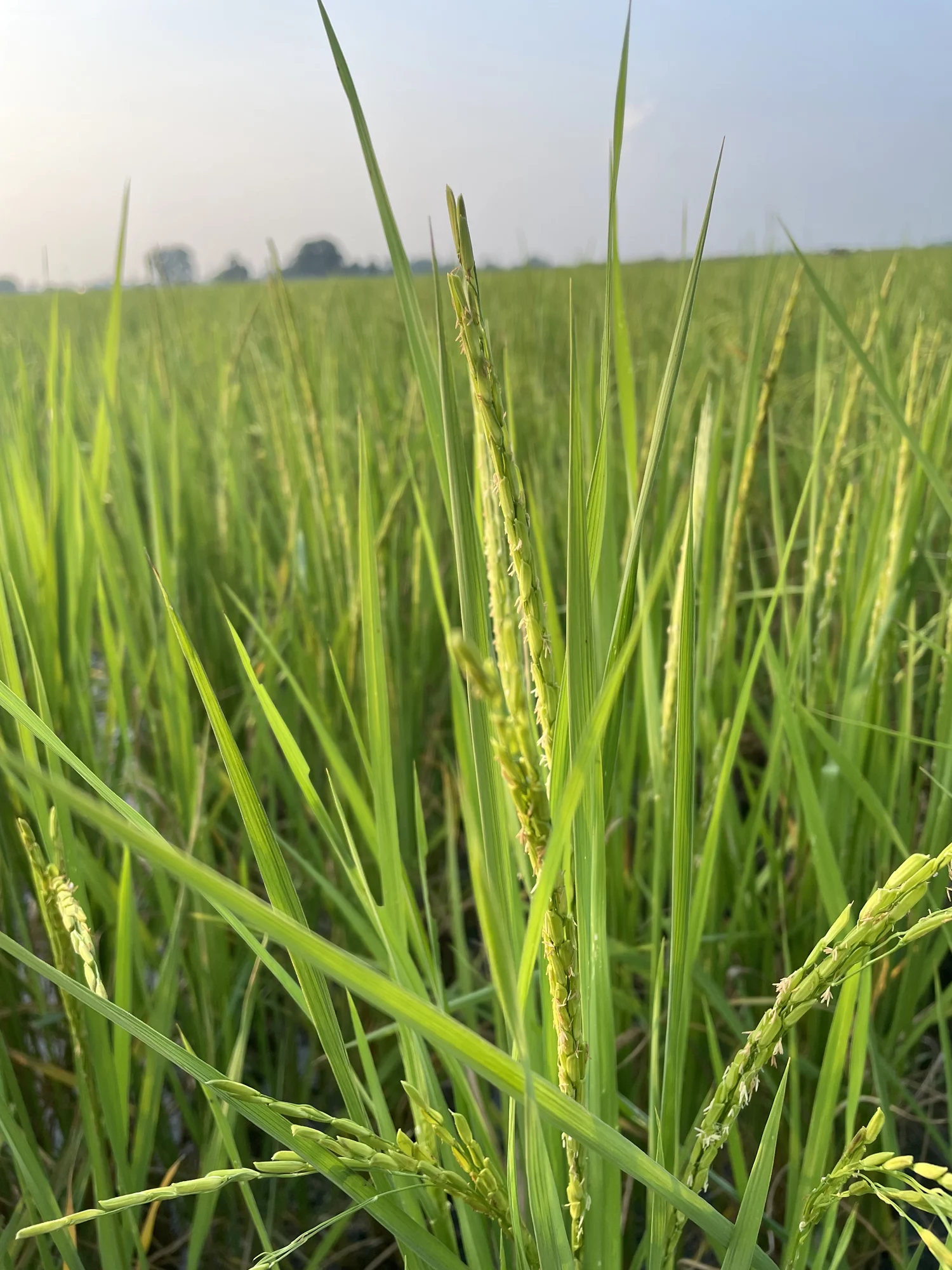
Panicle emergence gives the field a new appearance, but the plant still has more to do. Flowering is followed by grain filling, when the developing grains gain substance, and then ripening. A green head above the leaves is therefore a stage on the way to harvest; its appearance alone cannot tell us the final weight of grain. FAO's reproductive and ripening stages [1]
This helps explain the different views across our fields. Panicles only beginning to emerge in one crop and a small patch already harvested elsewhere do not belong to one shared countdown. The variety, establishment date and conditions in each field remain part of the season.
A patch grown for home
Navara had been planted as a small experiment for our own consumption, rather than for sale, and by 18 October it had been harvested. Its place in the season was different from the larger rice planting: a household trial reaching harvest while other fields still needed attention.
Two days later, the Jhanga removal in 1718 was finished, with that crop still standing. That is where this account leaves the season: one small harvest in, developing panicles elsewhere, and months of nursery work, transplanting, pumping, feeding and hand removal behind the rice still in the field.
A closer look at the varieties
Aromatic rice is a much wider world than Basmati. Vishnu Bhog has small, fragrant grains; Kala Namak carries its own aroma beneath a dark husk; Pusa Basmati 1718 is known for its long, slender grain. Their differences continue in the field, where one variety can be approaching harvest while another still has weeks of growth ahead.
The table compares published reference profiles. Our field records use the shorter names 1718 and Sonam; the Pusa and Ankur profiles below remain comparisons until the exact farm seed selections are confirmed.
| Variety or selection | Grain and character | Published maturity reference |
|---|---|---|
| Vishnu Bhog — traditional type | Aromatic, short-grained rice. The traditional parent described by BARC is tall-growing. | 142–145 days. The separate improved selection, Trombay Chhattisgarh Vishnubhog Mutant (TCVM), is earlier at 120–125 days; the two should not be confused. BARC variety comparison [6], BARC grain description [7] |
| Pusa Basmati 1718 | Strongly aromatic, long, slender grains; developed from Pusa Basmati 1121 with bacterial-blight resistance. | 136–138 days from sowing, according to IARI's published profile. IARI maturity profile [8], ICAR cultivar description [9] |
| Ankur Sonam | Fine grain that mills white; the producer describes good tillering, or the production of shoots from each plant. | 137–142 days, described by the producer as mid-to-late duration. Ankur Seeds profile [10] |
| Kala Namak | A scented rice associated with eastern Uttar Pradesh, named for its dark husk. Traditional tall types and newer, shorter selections differ. | In a 2023 KVK Basti field assessment, the local Kala Namak check matured in 155 days, compared with 145 days for Pusa Narendra Kala Namak-1. These are results for those entries, rather than one duration for every Kala Namak selection. TNAU variety background [11], KVK Basti assessment, printed p.20 [12] |
| Navara / Njavara | A traditional rice from Kerala, including red-grained types, with a much shorter crop cycle in published Kerala accounts. | Not settled by the name alone. A Kerala research paper describes 60–90 days, while TNAU's Navara listing gives 140 days. The references disagree; neither figure is a reliable forecast for our seed selection without establishing which profile applies. Kerala field study [13], TNAU Navara listing [14] |
Maturity figures depend on the selection, season and growing conditions. Only the 1718 source above explicitly defines its figure as days from sowing; the other references give crop duration or maturity without a clear starting point. They should not be read as days remaining after transplanting.
Reading nutrient requirements alongside the variety
A variety profile is a starting point for choosing how to grow the crop. Fertiliser needs also depend on soil fertility, previous crops, organic inputs and establishment method. PAU's Punjab guidance, for example, gives different nitrogen schedules for transplanted and direct-sown Basmati, with further changes after green manuring or incorporating summer-moong residues. That is why a single NPK dose beside each variety would leave out important parts of the decision. PAU's regional cultivation guidance [15], IRRI on field-specific nutrition [16]
Sources & further reading
- FAO's account of rice growth Accessed 2026-10-28
- IRRI on crop nutrition Accessed 2026-10-28
- University of Florida on plant nutrients Accessed 2026-10-28
- University of California on potassium in rice Accessed 2026-10-28
- National Plant Protection Centre's leafroller description Accessed 2026-10-28
- BARC variety comparison Accessed 2026-10-28
- BARC grain description Accessed 2026-10-28
- IARI maturity profile Accessed 2026-10-28
- ICAR cultivar description Accessed 2026-10-28
- Ankur Seeds profile Accessed 2026-10-28
- TNAU variety background Accessed 2026-10-28
- KVK Basti assessment, printed p.20 Accessed 2026-10-28
- Kerala field study Accessed 2026-10-28
- TNAU Navara listing Accessed 2026-10-28
- PAU's regional cultivation guidance Accessed 2026-10-28
- IRRI on field-specific nutrition Accessed 2026-10-28